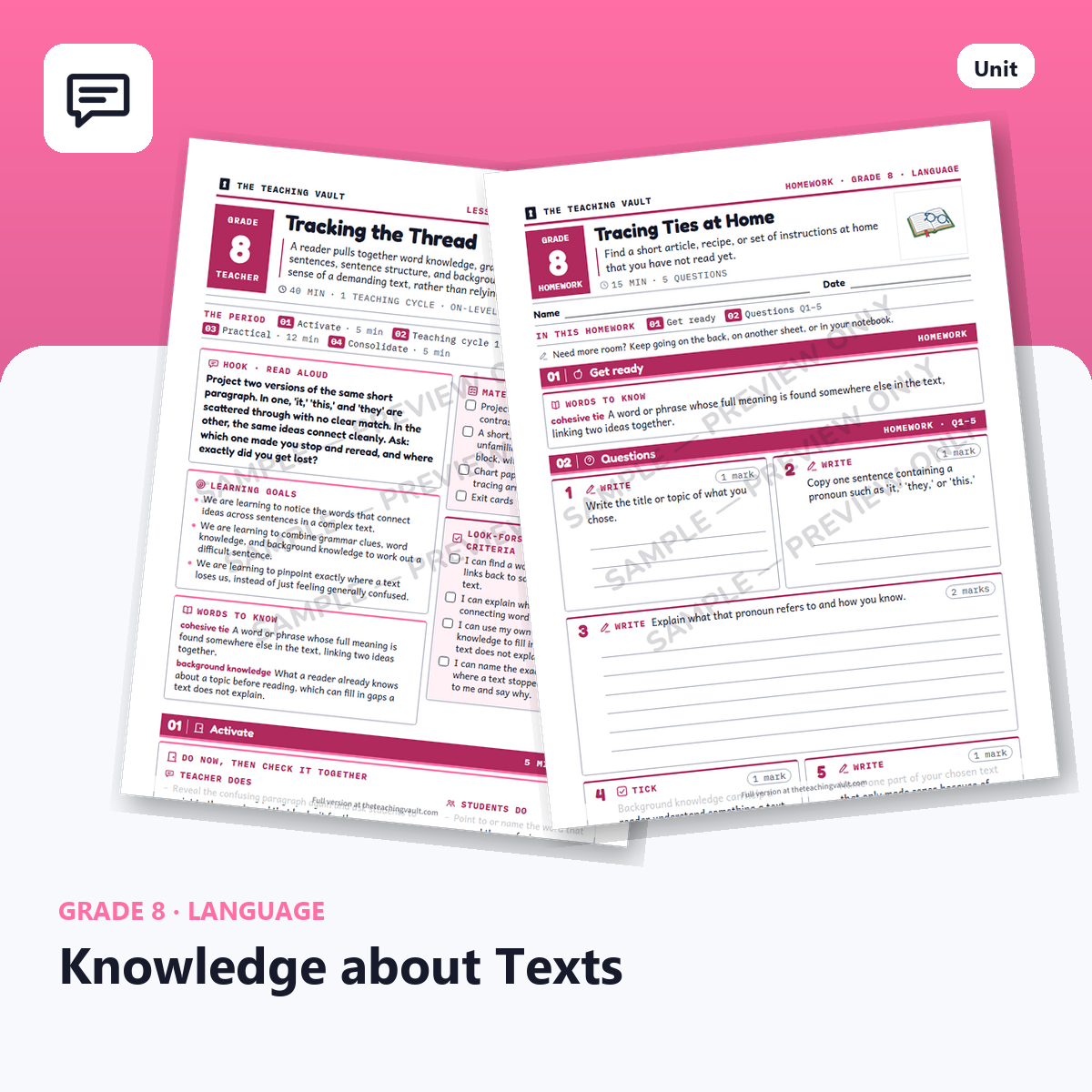
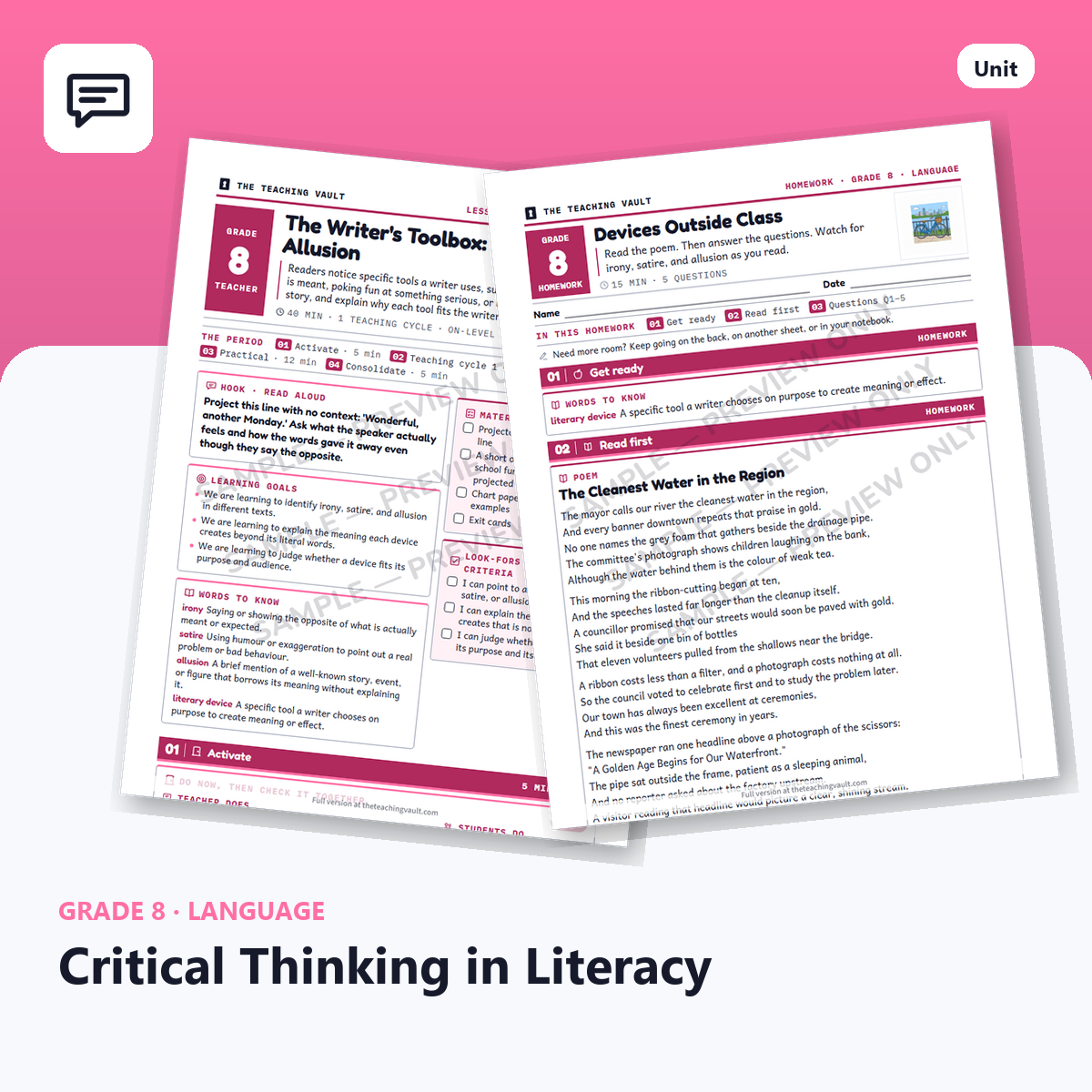


Description
All 8 lessons are complete — identify irony, satire, and allusion in different texts, make inferences using small clues within a single sentence or paragraph, judge how reliable different pieces of information are, identify cultural details in a text, such as customs, values, or everyday roles, identify a text's stated and unstated perspective, name a text's real topic. This can be diversity, inclusion, or accessibility, compare two texts by First Nations, Métis, or Inuit creators. We look at how a historical period or event shaped each one, and assess how well we used a thinking skill from this unit.
Every lesson comes with a full teaching set: a lesson plan, a worksheet, homework, and a handout. The unit also includes 8 exit cards, 2 quizzes, a project, and an assignment.

Grade 8 · ready for Monday
What's in this unit
-
1

Plan
8 lesson plans, each one 40-minute period, with what to say and what to watch for.
-
2
Slides
The lesson on the board, one step at a time, with each answer on the next slide.
-
3

Printouts
A worksheet, a handout and homework for every lesson.
-
4

Assessment
8 exit cards, 2 quizzes, a project, an assignment.
-
5
Answer keys
At the back of every worksheet, homework and assessment.


The 8 lessons
- 1
 The Writer's Toolbox: Irony, Satire, and Allusionidentify irony, satire, and allusion in different texts, explain the meaning each device creates beyond its literal words, and judge whether a device fits its purpose and audience
 - 2Reading Between the Linesmake inferences using small clues within a single sentence or paragraph, make inferences using the bigger picture across a whole text, and support an inference with the exact evidence that led to it
- 3Building One Conclusion from Many Sourcesjudge how reliable different pieces of information are, combine information from more than one source into one picture, and put ideas in a sensible order and reach a supported conclusion
- 4What a Text Carries From Its Worldidentify cultural details in a text, such as customs, values, or everyday roles, investigate what those details actually mean, and explain how those details add meaning to the text as a whole
- 5Whose Side Is This Text On?identify a text's stated and unstated perspective, evaluate evidence that suggests a perspective is biased, and suggest a specific way to reduce that bias
- 6What This Text Is Really Sayingname a text's real topic. This can be diversity, inclusion, or accessibility, respond to a text's message, and spot different positions inside one text
- 7Comparing Two Voices, Two Timescompare two texts by First Nations, Métis, or Inuit creators. We look at how a historical period or event shaped each one, compare how cultural experience shapes those texts, and connect what the texts show to current lived experience
- 8Naming My Thinking, Setting My Goalassess how well we used a thinking skill from this unit, give clear proof that a skill worked, and set a real, doable goal to improve a thinking skill

- Read-Me-First — open it before anything else; one page that says what each file is for
- One numbered zip per lesson: lesson plan, worksheet, homework, handout and a one-page lesson read-me
- A zip for the 8 exit cards; a zip for the assessments: 2 quizzes, a project, and an assignment
- Every file as a print-ready PDF and an editable Word document; the lesson plan also as a PowerPoint deck to project
In every lesson
- Lesson plan
- Worksheet
- Homework
- Handout
For the whole unit
- 8 exit cards
- 2 quizzes
- A project
- An assignment
- Every format included — PDF, DOCX & PPTX
- The Writer's Toolbox: Irony, Satire, and Allusion
- Reading Between the Lines
- Building One Conclusion from Many Sources
- What a Text Carries From Its World
- Whose Side Is This Text On?
- What This Text Is Really Saying
- Comparing Two Voices, Two Times
- Naming My Thinking, Setting My Goal
- Each lesson fits one 40-minute period; the plan is written for a substitute to teach cold
- Prints cleanly in black and white; nothing depends on colour
- Answer keys on the teacher pages at the end of every worksheet, homework and assessment
- In My files right away, and by email.
- Zips open on any computer; on a phone, save them to Files or Drive first
- Licensed to one teacher for one classroom — not for sharing with colleagues or your school. Full licence terms
- Digital files are final sale; if something is wrong with a file we'll fix it
- Questions: support@theteachingvault.com
Reviews
You may also like

Language
Grade 8 Developing Ideas and Organizing Content — Full Unit Try Lesson 1 free5 lessons

Language
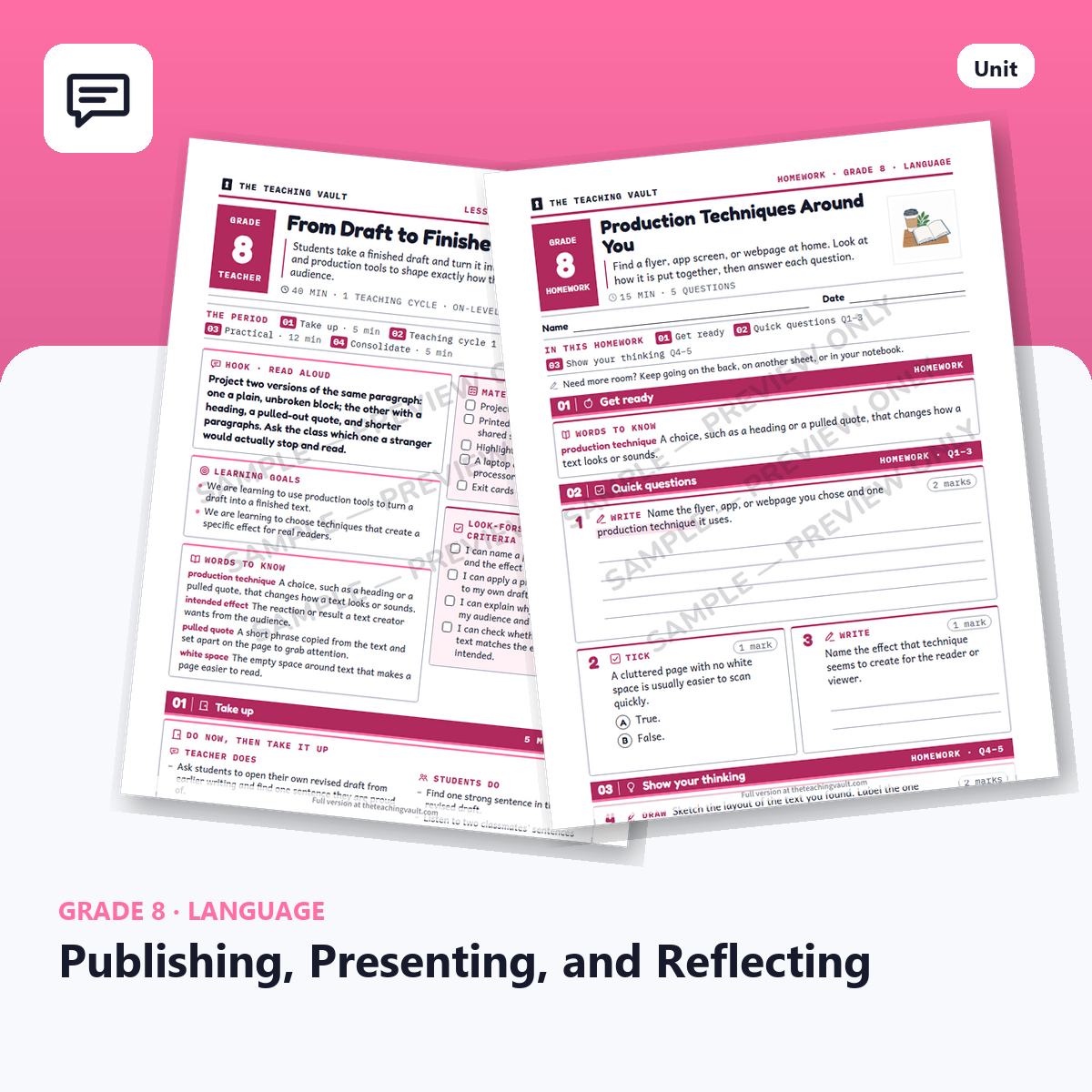
Grade 8 Publishing, Presenting, and Reflecting — Full Unit Try Lesson 1 free3 lessons


Language
Grade 8 Applications, Connections, and Contributions — Full Unit Try Lesson 1 free3 lessons

Language
Grade 8 Oral and Non-Verbal Communication — Full Unit Try Lesson 1 free5 lessons

Language
Grade 8 Language Foundations for Reading and Writing — Full Unit Try Lesson 1 free3 lessons
Language
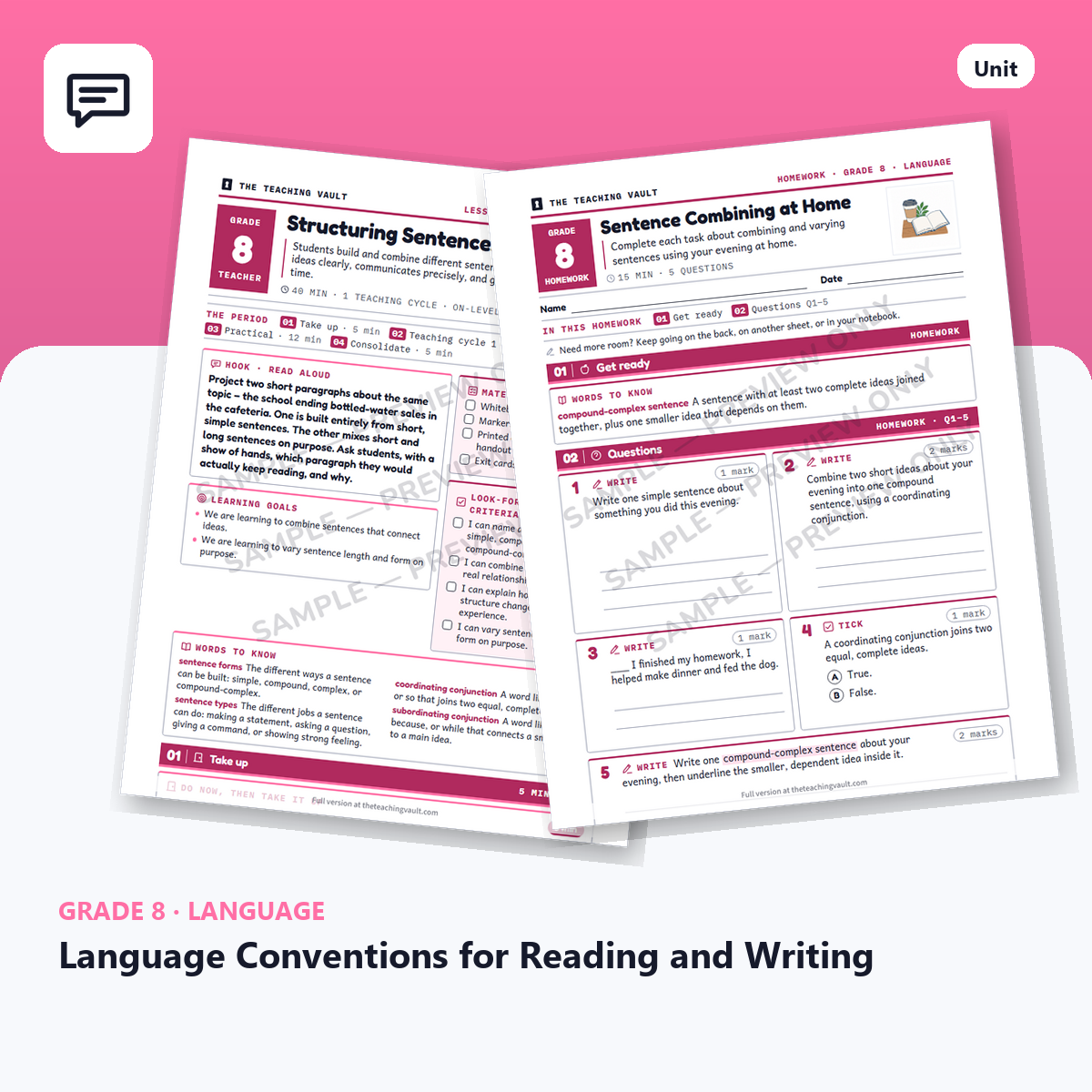
Grade 8 Language Conventions for Reading and Writing — Full Unit Try Lesson 1 free3 lessons